 From the time I was a young girl, I always wanted to be a mother. I assumed that I would have my children young. (I didn’t.) And, because I never suffered with any “women’s troubles”, I also assumed that I would have a wonderful pregnancy. I had visions of pregnancy as a joyful time of eating bon-bons and wearing cute maternity clothes. For some reason, even the idea of childbirth itself didn’t trouble me particularly. I had a lot of faith in Western medicine and was confident an epidural would take care of all that. So, when I found out that I was expecting, I was thrilled. I raced out to buy my obligatory copy of What to Expect When You are Expecting. And I made a long list of possible names.
Exactly six weeks and one day into my pregnancy, I felt a little ill following breakfast. I raced to the bathroom to throw up - and never stopped.
At first, I was sure that it was typical morning sickness. I tried various wisdom remedies. The ever-present cracker, ginger tea, sucking on a lemon, motion sickness bands, over the counter nausea syrup, etc. I’m fairly certain there is nothing I didn’t try. A couple of weeks later, the nausea and vomiting was steadily increasing. I wasn’t functioning at work. I was there, but often yakking in the bathroom. I had attempted to keep my pregnancy quiet at work, but my obvious sickness made it an open joke.
Everyone, including me and my doctor, thought it would go away. But it didn’t. After a couple of incidents of in-office IV fluids, I was prescribed Phenergan. It barely touched the vomiting, but did nothing for the nausea. What it did do was keep me so heavily sedated that I could sleep away a lot of my misery. But my performance at work suffered — a lot. I was just showing up, in between days of not. After being admitted to the hospital for a couple of days due to dehydration and high ketone levels in my urine, I was prescribed the anti-emetic Zofran. (Zofran is often used with chemo patients suffering from nausea.) At that time, it was over $1000 a month - with insurance. I ended up finding a Canadian pharmacy and had it shipped to me for around $350 for a three-week supply. On Zofran, I was down to once or twice a day vomiting. That enabled me to keep things down a bit better, but the nausea remained for the duration.

Please do not ask a hyperemesis sufferer if she has “tried eating a cracker”.
It was during that time that I learned the name of what I really had. Hyperemesis Gravidarum. Hyperemesis occurs in less than 2% of pregnancies and is marked by dehydration, malnutrition, and other serious complications. In its most severe form, renal failure and even death can occur. (Although, with the advent of total parenteral nutrition and medications, this is rare today.) The writer Charlotte Bronte (Jane Eyre) is thought to have died from hyperemesis. Approximately 10% of HG pregnancies are terminated for the health of the mother.
Emotionally, I sank to levels of self-pity that I’m not proud of. Even though I knew that having a terminal illness or chronic condition wasn’t at all the same thing (for my having a light at the end of the tunnel), I suddenly empathized with everyone who had ever endured chemotherapy. I wasn’t in pain. I still don’t know what day in and day out pain feels like. But I know all about the effects unrelenting nausea and vomiting.
I was vomiting blood for 8 months. Your throat gets so irritated, that you pass blood when you throw up. I sported petechial hemorrhages all around my eyes for the duration of my pregnancy due to all the vomiting. And I popped a few blood vessels in my eyes as well. Riding in a car can feel akin to hurtling down a roller coaster. There were few, few moments at all that I wasn’t distinctly aware of being pregnant. Simply because I was so sick. I felt the urge to throw up every moment of every day - without fail. It was suffering on a scale I am shaken to remember. (I don’t think there has ever been a woman quite so happy as I to be induced with Pitocin. Ironically, for all the misery of the pregnancy, my delivery was a breeze.) But for months afterwards, I experienced depression. My body was greatly weakened. Four days after I delivered, I was 20 pounds less than when I got pregnant. It took weeks for the nausea to slowly ease and for me to be able to eat anything resembling a full meal.

The inventor of Zofran has assuredly been reserved a nice pad in Heaven.
But what exacerbated the misery of it all was the ignorance of family, friends, and acquaintances who’d never heard of hyperemesis. When it is explained to them, many respond with suspicion. It is assumed that hyperemesis is just a pretty name for the morning sickness that most pregnant women experience at some time. So, sufferers get a lot of unhelpful advice. If only I had the proverbial dime for every cracker discussion I endured. People suspect what they don’t understand, and they judge accordingly. I was given guilt trips for losing weight, told that I wasn’t taking care of my baby by being so nutritionally depleted, given condescending pats, assured it would go away, and even told that I was “lucky” they didn’t treat me with what they used to do for hysterical pregnant women — locking them in a dark room until they no longer complained of nausea. It’s bad enough being sick all the time. It’s even worse to be told that you are imagining it or you are a hypochondriac — simply because it is beyond their understanding.
Following my first pregnancy, I was erroneously told that the likelihood of experiencing hyperemesis again was less than 10%. (The actual figures are 50/50 and possibly higher. After two hyperemesis pregnancies, it is all but certain you can count on a third.) Wanting another child close in age to my first, I didn’t take the risk seriously enough. Hyperemesis pregnancies should be planned. There are high-risk obstetricians with experience in dealing with it. There are even now 24 hr. Zofran pumps that a woman can wear and go about her daily life. It is really important to be in the best shape possible before getting pregnant again. I didn’t. I got pregnant again less than one year later. The second pregnancy was much worse, finally resulting in me having to go out on disability until delivering.
Your next question is likely to be one I have wondered for some time. No, there are not any reported links between autism and a hyperemesis pregnancy that I can find. However, hyperemesis is not exactly a popular subject of scientific study. You can find message board threads of HG moms wondering the same thing. Since the causes of autism have not been anywhere close to being sorted out, and - since the causes are likely to be varied and many - I doubt anyone could say. However, there is some suggestion that an “environmental insult” during pregnancy could be a cause of autism. I have my suspicions, and I’m curious to see what science comes up with regarding a possible link between the two. I don’t think it is beyond the realm of possiblity that nutritional depletion of its mother could be an “environmental insult” to a fetus. I will say that the concern is yet another reason I have chosen to not have the third child I have always wanted. My children were well worth the hyperemesis, but I would not want it to endanger a third child.
It has been three and a half years since my last pregnancy. And I’m still not back to normal. I have no idea why. I still wake up most mornings slightly nauseous until I get moving. Motion sickness is an everyday problem for me. I have a hair-trigger gag reflex and am much more sensitive to smells and medications. Now I understand why bulimics have trouble learning to eat again. It’s because vomiting is a reflex that can be hard to break when you are in the habit. My mind knows I’m no longer pregnant. But my body will not forget. And, while it has occurred to me that I’m simply crazy, there are too many similar postpartum reports from other women like me to think that it is all in my head. Hyperemesis can, apparently, have effects lasting for years.
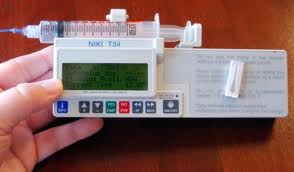
A Zofran pump delivers a constant dose of medication that is often more effective than pills.
I wish that I had known more about it before going through it twice. I adored my doctor and midwives. But, in hindsight, I know I would have been better off seeing a specialist with experience in dealing with hyperemesis. (I sure wish I’d known about that pump.) But it taught me a lot of things. It taught me compassion for those who suffer. It taught me to assume nothing about subjects I’m unfamiliar with and to avoid judging others. It taught me how to endure. And I learned a lot about who my friends really are.
If you want to learn more about Hyperemesis Gravidarum or you are seeking to prepare for a pregnancy with it, I highly recommend visiting HelpHer.org. In addition to information, you can find support there as well as a list of doctors with experience in treating patients with the disorder. That could make all the difference for you for someone you love.
Note: I am NOT saying that autism is caused by hyperemesis. I’m just saying that I am a human being and that human nature is to wonder. Since there is no definitive list of causes for autism, and since they are likely to be many, I am merely saying that I wondered if one day a link between maternal nutritional deficiencies and autism might be found. Obviously, being a mother of an autistic child, I would never dream of attempting to “blame” women for their children’s autism. For anyone insisting upon being overly sensitive, I might point out that there are, in fact, causes somewhere and that wishing there weren’t won’t change anything. In the end, science will tell the story. :)

 Yes, we have words. But with that, we have so much more. We have hope. And a song in our hearts — whose tune we have sometimes forgotten.
 When you have a young child with special needs, it is only a matter of time before you are asked a very personal question. Are you planning to have another child?